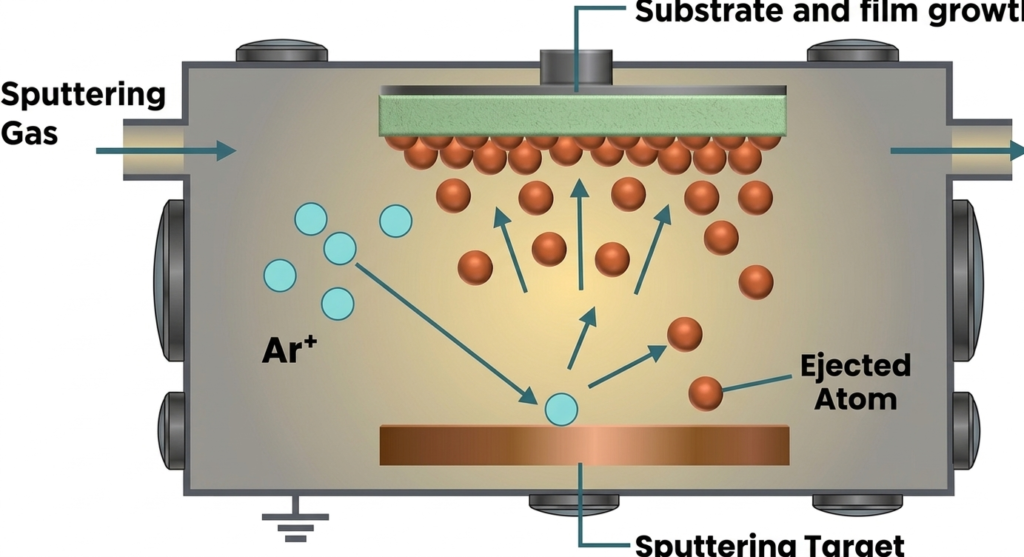
Sputtering is one of the most widely used physical vapour deposition (PVD) techniques for producing thin films, from optical coatings on lenses to metal contacts on semiconductor devices. It is valued for producing dense, well-adhered films across a very broad range of materials, including metals, alloys and compounds such as oxides and nitrides.
THE HEX SERIES
How Does Magnetron sputering work?
In magnetron sputtering, a target made of the material to be deposited is placed inside a vacuum chamber and bombarded with high-energy ions from a plasma, typically generated in argon gas. The impact of these ions dislodges, or “sputters”, atoms from the target surface. These atoms travel through the chamber and condense on the substrate, gradually building up a thin film.
A magnetron source uses an arrangement of permanent magnets positioned behind the target. The resulting magnetic field traps electrons close to the target surface, increasing the local plasma density and ionisation efficiency. This allows sputtering to take place at lower gas pressures and significantly higher deposition rates than simple diode sputtering, while keeping the plasma away from the substrate.